2026-09-27
"Borrowed Faces: A Close Reading Essay on Dispossession" by Emma Quỳnh Liên Wong
Through a close reading of Homer's Odyssey, the essay explores transformation, identity, and the unsettling loss of humanity that follows when we are made into something other than ourselves.
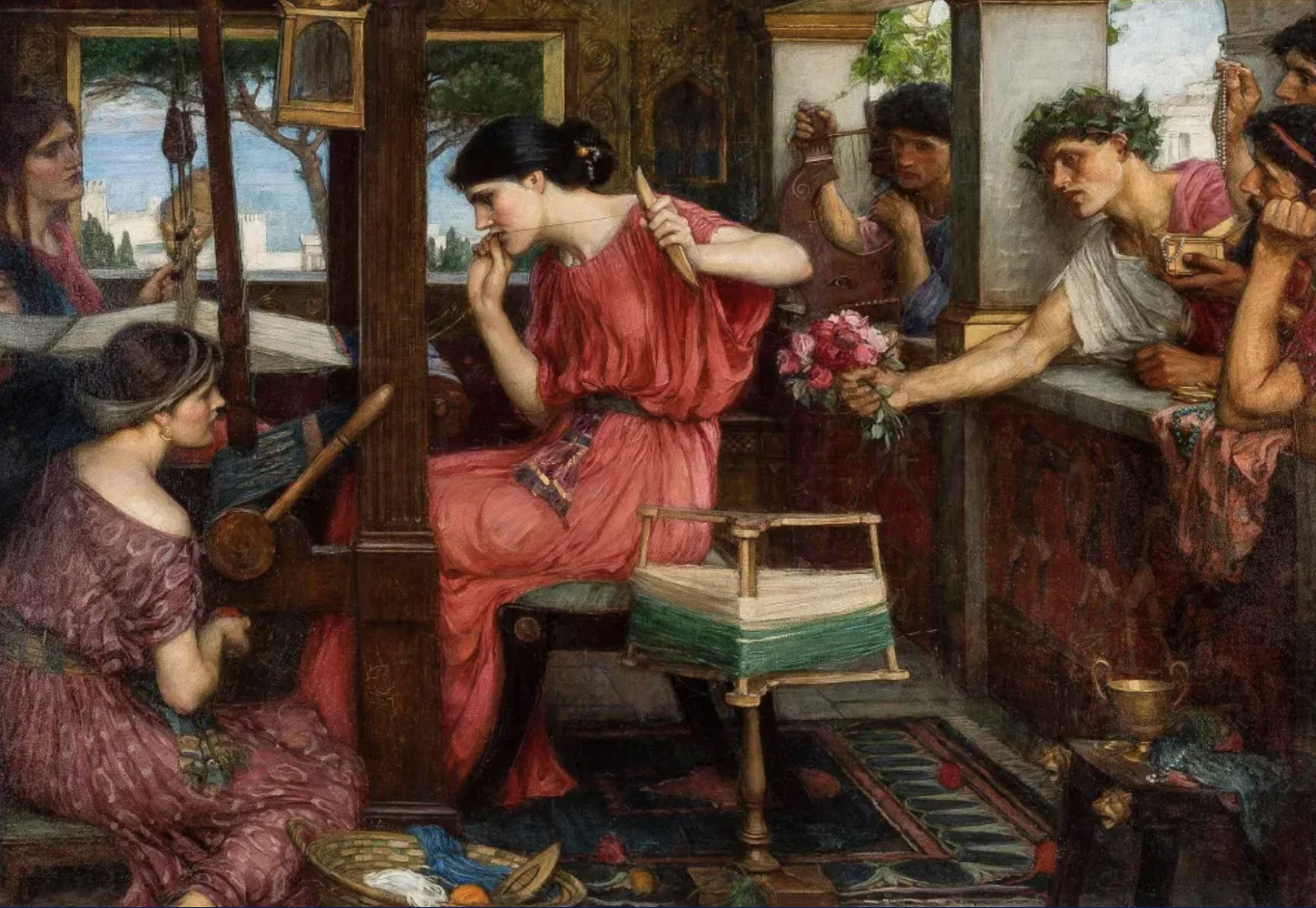
We have heard of the epic before. But perhaps The Odyssey endures because its monsters are not as distant as we imagine: Homer asks what remains of us when we surrender our agency, our appetites, and ultimately ourselves…
[…] the release of The Odyssey is […] an event to celebrate. In what we are told is the streaming era, this epic is bringing audiences back to cinemas. In what we are told is a time of declining literacy and the ‘death of the humanities’, translations of The Odyssey […] are flying off the shelves. Some of those who buy the book or show up in cinemas to watch Tom Holland may go on to study ancient Greek. (Quoted from Emily Wilson’s Review: An Uncomplicated Man)
At the end of Book XX, Homer sets the scene in Odysseus’ home on the night before the inevitable slaughter of the suitors. Here, The Odyssey dramatizes the suitors’ feast to expose their violation of xenia, prompting the goddess Athene to take hold of their laughter and appetite to expose the parasitic violence of their feasting; by targeting their jaws (the hinge of appetite and speech) the epic collapses the boundary between property and personhood. Those who cannot govern themselves cannot rightly possess another’s house - they have surrendered their agency, their right to their own humanity. The grotesque image of “eating blood” foreshadows the suitors’ eventual slaughter and symbolically figures justice as a redistribution of muscle, voice, household, and ultimately, self-mastery.
The dinner scene in the Odyssey consistently functions as a ritual of community. Whether in the ideal feasts of the Phaeacians or the splendid hall of Helen and Menelaus, banquets serve as the setting where stories are exchanged, news of Odysseus circulates, and wisdom is offered. All of this contrasts sharply with the suitors’ daily crime. We expect the halls of great Odysseus, the glorious epicenter of the epic, to be splendid and perfect, and yet when we are finally met with home (i.e., Ithaka), we are instead confronted with a perversion of xenia. Their parasitic violation of hospitality and their consumption of another man’s goods, stage the central tension of the passage in question: possession versus dispossession. The passage “now they laughed with jaws that were no longer their own” calls into question two levels of possession: the substance (i.e., what one materially has) and the bodily - in this case, the jaw (Odyssey 20.347). The jaw becomes the hinge of their own agency. It is the crux of where these two types of possession meet: the organ (the bodily) eats (substance). Athene’s intervention by “addl[ing] their thinking” first severs their mental control; immediately afterwards the epic shows the severance where it will be the most legible: they laugh with jaws that they no longer possess (Odyssey 20.346). What the suitors have taken (another’s substance) is answered by what is taken (their “own” jaws). The mouth’s doubleness matters. These men have been gluttons and scoffers: even as they consume what is rightfully Odysseus’ in his own home, they speak and treat the hero poorly (e.g., when Antinöos throws a stool at him). By targeting the jaws, the poem hits both transgressions at once: consumption and corrosive speech.
The suitors have long surrendered self-command to appetite: the moment there is rumour of Odysseus’ death, they storm his home, eat his substance, and attempt to take his wife and thus, his legacy. Athene does not create their loss of self so much as consummates it. “No longer their own” reads expository: to be the creature of your jaws is already to belong to another power (Odyssey 20.347). Odysseus’ virtue, on the other hand, is self-mastery: he is the master of disguises, he who can enter and exit identities without losing the core. In contrast, the suitors’ identities leak outward through their mouths involuntarily. Odysseus chooses when to put on his disguises: while he is both the great Odysseus in banquet halls, he is also Nobody. The suitors’ faces perform what they did not intend, and their sound betrays them - this is why the laughter here matters. Laughter is meant to be a social and harmless sound - it is delight performed! And yet, here, it becomes the sign of dispossession. The thing that should express mastery, that being carefree dominance in another man’s hall, issues without ownership. Perhaps the last line, “their laughter sounded like lamentation” is the sound of a subconscious grief, divinely ordained to bubble to the surface (Odyssey 20.349). They perform their “power” with borrowed faces.
In the five next words of the passage, the epic collapses the distance between the table and the floor where they will be killed: “The meat they ate was a mess of blood” (Odyssey 20.348). The suitors’ feast has always been theft - and now, it is visibly sacrificial. The lack of a priest to sanctify reinforces the profound mistake they have made; the suitors are the sacrifice to Odysseus’ homecoming. The phrase “a mess of blood” foreshadows and goes so far as to transfer the gore and bloodshed of Book 22 into Book 20 (Odyssey 20.348). They are already eating in the register of their own deaths. The visual of a plate filling with blood is grotesque: the suitors cannot seem to distinguish between the life they drain from the household and the life that will shortly drain from them. Possession has blinded them to the boundary between nourishment and violence and the divinely induced vision imposed makes that boundary bleed through the meat. It is no longer a question of “the meat they ate” - rather, this is a line about the meat they are, the meat they will become (Odyssey 20.348).
The Odyssey consistently treats substance as an extension of personhood: thus, the violation of the suitors is a double-edged sword - this is a matter of Odysseus’ goods and Odysseus’ self. Because of this, it is easy to assume an agency of the household. With the help of the divine, the room seems to repossess itself by possessing the suitors’ bodies. The hall, which they thought to occupy, occupies them: “and the walls bleed, and the fine supporting pillars” (Odyssey 20.354). “Their eyes bursting / full of tears” marks another border that is crossed: moisture that belongs to the body is about to spill into the common space “like lamentation” (Odyssey 20.348-9). The legacy and substance of Odysseus (and therefore an extension of Odysseus) have already begun to take back - this will only serve to echo the ensuing slaughter.
This passage is one of reversal; it prepares us for the death of the suitors not simply by hinting at the gore but through dispossession itself - the suitors’ loss of self, property, and bodily autonomy. The laughter that is supposed to be a moment of delight is one of lamentation; the ritualistic feast of community is instead of sacrifice. Their jaws are no longer their own, causing appetite and speech to collapse into a single moment… and we, as the reader or perhaps as the listener in the way the epic would have been performed, find ourselves at this level of violence. One could say “a mess of blood” (Odyssey 20.348). In this reversal, the Odyssey makes it clear over and over again: substance and the self cannot be separated. The laughter, the suitors’ jaws, their bodies - it all testifies to the truth that those who cannot rule themselves cannot possess another’s house, much less possess their own.
Works Cited
Homer, and Richmond Lattimore. The Odyssey of Homer. New York, NY: Harper Perennial Modern Classics, 2007.